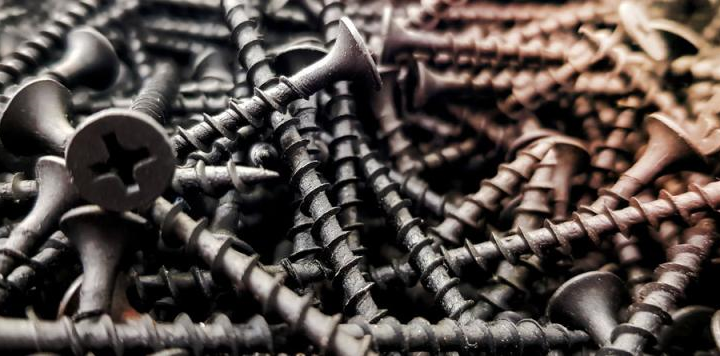
When you need a fastener finish that won‘t break the bank, plays well with paint, and gives you consistent torque control, phosphate coating (often called phosphating) is often the answer. Unlike zinc plating (which deposits metal) or black oxide (which simply discolors the surface), phosphating creates a crystalline conversion layer that chemically bonds to the steel. It’s not the most corrosion-resistant finish on the market, but for many industrial and automotive applications, its unique combination of benefits makes it the right choice.
What Is Phosphate Coating (Phosphating)?
Phosphate coating is a chemical conversion coating applied to steel, iron, zinc, or aluminum parts. The fastener is immersed in a bath of phosphoric acid and phosphate salts, which react with the metal surface to form a layer of insoluble phosphate crystals that are integrally bonded to the base material. Phosphating typically produces a coating thickness ranging from 2 to 15 microns (0.08–0.6 mils), depending on the type and intended application. Phosphate coatings are most effective on ferrous metals; aluminum and stainless steel do not form phosphate coatings properly.
The porous, crystalline structure of a phosphate coating serves three main purposes:
-
Corrosion protection — when combined with oil, wax, or paint
-
Paint adhesion — as an excellent primer/base coat for subsequent organic coatings
-
Lubrication and friction control — the porous surface retains oil, reducing friction and enabling consistent torque-tension performance
The main purpose of phosphating is: to provide protection to the base metal and prevent the metal from being corroded to a certain extent; for primer before painting to improve the adhesion and anti-corrosion ability of the paint film; to reduce friction in the metal cold processing use for lubrication.
Zinc Phosphate vs. Manganese Phosphate: Two Main Types
The two most common phosphate coatings used on fasteners are zinc phosphate and manganese phosphate. They serve different purposes and are not interchangeable.
| Aspect | Zinc Phosphate | Manganese Phosphate |
|---|---|---|
| Appearance | Dark gray to black | Darker, blacker finish |
| Crystal structure | Fine-grained, microcrystalline | Coarser crystalline |
| Coating weight | ~500–1,850 mg/ft² | ~1,500–3,000 mg/ft² (heavier) |
| Thickness | Typically 5–15 μm | Typically 10–15 μm |
| Primary strength | Paint adhesion, lubrication | Wear resistance, anti-galling |
| Corrosion resistance | Good (with oil) | Better than zinc phosphate |
| Wear resistance | Moderate | Excellent — hardest of all phosphate coatings |
| Typical fastener applications | Pre-paint primer, general industrial fasteners | Engine/transmission internal fasteners, sliding components |
| Application method | Immersion or spray | Immersion only |
Zinc Phosphate — For Paint Adhesion and Lubrication
Zinc phosphate produces a fine-grained crystalline layer that bonds strongly to the surface, making it an ideal primer for paint, powder coat, or e-coat. It‘s lighter than manganese phosphate and offers good lubricity when oiled. Common on fasteners, brackets, and housings where corrosion protection is needed before painting.
Zinc-based phosphating has relatively low hardness, high porosity, and good adhesion to electrophoretic paint, and there is a phenomenon of powder falling, so it cannot be used in environments where cleanliness is required in the casing of engines and transmissions. Generally used on fasteners that are electrophoresed with the body or other parts.
Manganese Phosphate — For Wear Resistance and Anti-Galling
Manganese phosphate forms a harder, darker finish than zinc phosphate and offers superior wear resistance, lubricity, and anti-galling properties. This makes it well-suited for parts that move or experience friction — bearings, gears, bushings, fasteners, and engine parts. Manganese phosphate has high hardness, close grain arrangement, and stable friction factor, making it generally used in the casing of engines and transmissions.
Other Types
Beyond these two, other phosphate systems exist but are less common on fasteners:
-
Iron phosphate — very thin (30–90 mg/ft²), economical, used primarily as a paint base for appliances and light industrial parts
-
Zinc-calcium phosphate
-
Amorphous iron phosphate
The Phosphating Process
Phosphating is a chemical process that requires precise control of temperature, time, and solution chemistry. A typical fastener phosphating line includes these steps:
-
Degreasing and cleaning — removes oils, dirt, and manufacturing residues
-
Rust removal (pickling) — removes existing rust and scale
-
Water rinsing — removes cleaning residues
-
Surface adjustment (activation) — prepares the metal surface for uniform crystal formation
-
Phosphating bath — parts are immersed in a heated phosphate solution (typically 60–95°C depending on type); the chemical reaction forms the crystalline phosphate layer
-
Water rinsing — stops the reaction and removes residues
-
Sealing / post-treatment — oil, wax, or organic sealer is applied to fill the porous coating
-
Drying
The phosphate coating process relies on the basic pickling reaction that occurs on the metal fastener when the process solution comes in contact with the metal. Treatment temperature varies by type: normal temperature phosphating (no heating), low temperature phosphating (25–45°C), medium temperature phosphating (60–70°C), and high temperature phosphating (>80°C). Zinc phosphate can be applied by immersion or spraying; manganese phosphate is applied only by immersion.
Key Advantages of Phosphate Coating for Fasteners
✅ Low Cost
Phosphate coating is relatively cheaper than galvanizing, especially when heavy deposits are required. It is one of the most economical conversion coatings available.
✅ No Hydrogen Embrittlement Risk
Unlike electroplating (which involves acid pickling and electrolysis), the phosphating process does not introduce hydrogen into the steel. This makes it a safe choice for high-strength fasteners (10.9, 12.9 grades) where hydrogen embrittlement is a critical concern.
✅ Excellent Paint Adhesion
The porous, crystalline surface provides outstanding mechanical keying for paint, powder coat, and e-coat. Phosphate coatings can be used as an undercoat to improve the corrosion resistance and adhesion of a subsequently applied top coat (e.g., organic coating).
✅ Consistent Torque-Tension Performance
One of the most valuable benefits for assembly operations: phosphate coating with oil can be used to impart a controlled torque/clamping force relationship to a threaded fastener. The phosphate layer retains oil, providing consistent lubrication during tightening — resulting in predictable clamp load and reducing assembly variation.
Zinc phosphate combined with an oil finish is one of the most cost-effective treatments for steel fasteners. This phosphating process enhances surface texture and improves lubricant retention, making it ideal for applications where consistent torque is required.
✅ Good Corrosion Resistance (When Oiled)
Phosphate coating alone provides minimal corrosion protection — it’s the oil (or other sealer) held in the porous coating that does the heavy lifting. After phosphating, oil should be applied, and the level of corrosion resistance is closely related to the performance of the oil coating. With oil, zinc phosphate fasteners typically achieve 2–72 hours neutral salt spray (NSS) to red rust. While modest compared to zinc plating (72–200+ hours), this is sufficient for many indoor and protected applications.
Manganese phosphate offers better corrosion resistance than zinc phosphate and can be used at 107–204°C.
✅ Reduced Friction and Anti-Galling
The phosphate coating, especially when oiled, reduces friction during assembly and prevents galling (cold welding) — a particular risk with stainless steel fasteners.
✅ Dimensional Stability
Phosphate coatings are thin (2–15 μm) and do not significantly alter fastener dimensions, unlike hot-dip galvanizing which requires oversized tapping.
Limitations to Consider
| Limitation | Implication |
|---|---|
| Minimal corrosion resistance without oil | Bare phosphate coating (no oil) provides almost no rust protection — oil is essential |
| Corrosion resistance lower than zinc plating | Salt spray hours are typically 2–72 hours vs. 72–200+ for zinc plating |
| Oil can dry out over time | Corrosion protection diminishes as oil evaporates; may require re-oiling |
| Not suitable for severe outdoor environments | For marine or high-humidity outdoor use, consider zinc flake or hot-dip galvanizing |
| Powdering (zinc phosphate) | Zinc-based phosphating has relatively low hardness, high porosity, and there is a phenomenon of powder falling, so it cannot be used in environments where cleanliness is required in the casing of engines and transmissions |
Typical Applications
Zinc Phosphate & Oil
-
Industrial fasteners where consistent torque is required
-
Fasteners that will be e-coated or powder-coated (primer/base coat)
-
Automotive body fasteners (before electrocoat)
-
General machinery assembly
-
Internal or dry-environment use
-
Meets specifications such as MIL-DTL-16232 or GMW3179
Manganese Phosphate & Oil
-
Engine internal fasteners (valve train, timing components)
-
Transmission fasteners and internal components
-
Sliding components requiring wear resistance
-
Firearms and military components (often called “Parkerizing”)
-
Heavy machinery bearings and bushings
Summary: Phosphate Coating (Phosphating) at a Glance
| Aspect | Summary |
|---|---|
| What it is | Chemical conversion coating forming crystalline phosphate layer |
| Main types | Zinc phosphate (paint base, lubrication) and manganese phosphate (wear resistance) |
| Thickness | 2–15 μm |
| Corrosion resistance | Minimal (coating alone) to low (with oil) — 2–72h NSS |
| Hydrogen embrittlement | No risk — safe for high-strength grades (10.9, 12.9) |
| Torque-tension performance | Excellent — oil-retaining surface provides consistent friction |
| Paint adhesion | Excellent — ideal primer/base coat |
| Cost | Very low — one of the most economical finishes |
| Standards | ISO 9717, ASTM F1137, BS 7371-9, MIL-DTL-16232 |
| Best for | Indoor/dry environments, pre-paint applications, torque-critical assemblies, high-strength fasteners needing no hydrogen risk |
| Not suitable for | Severe outdoor/marine environments (use zinc flake or HDG instead) |
Frequently Asked Questions
Q: Is phosphate coating the same as Parkerizing?
A: Yes. Parkerizing is a brand name often used for manganese or zinc phosphate coatings, especially in firearms applications.
Q: Does phosphating prevent rust?
A: By itself, very little. The corrosion protection comes from the oil that fills the porous coating. Without oil, phosphated fasteners will rust quickly. With oil, they provide modest protection suitable for indoor and dry environments.
Q: Can I paint over a phosphate coating?
A: Yes. In fact, phosphate coating is specifically designed as an excellent primer for paint, powder coat, and e-coat. The porous crystalline surface provides outstanding mechanical adhesion.
Q: Is phosphating safe for high-strength bolts (10.9, 12.9)?
A: Yes. Unlike electroplating, the phosphating process does not introduce hydrogen into the steel, eliminating hydrogen embrittlement risk — a critical advantage for high-strength fasteners.
Q: How does phosphate coating compare to zinc plating in cost?
A: Phosphate coating is generally cheaper than zinc plating, especially when heavy deposits are required. However, its corrosion resistance is also lower.
 No products in the cart.