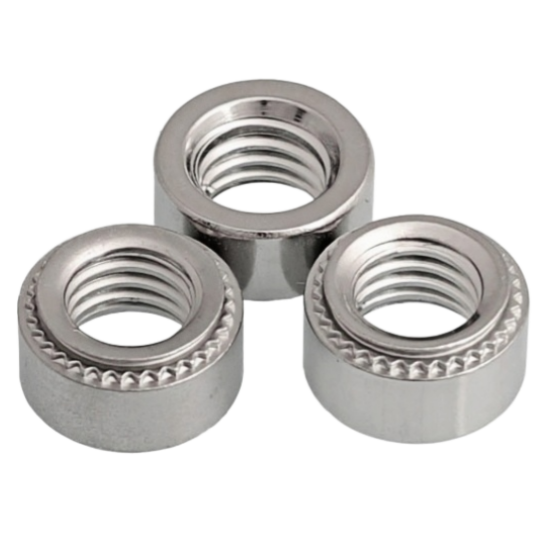
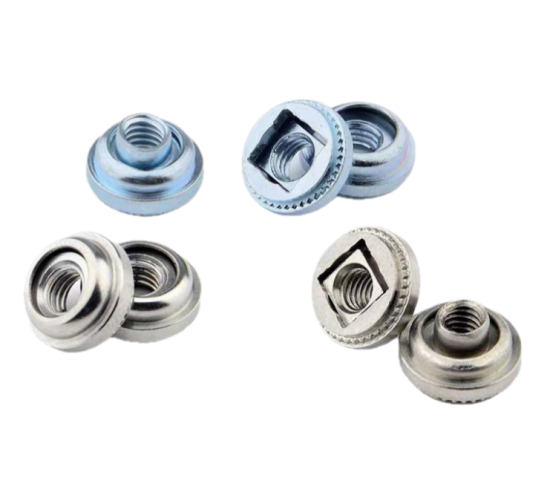
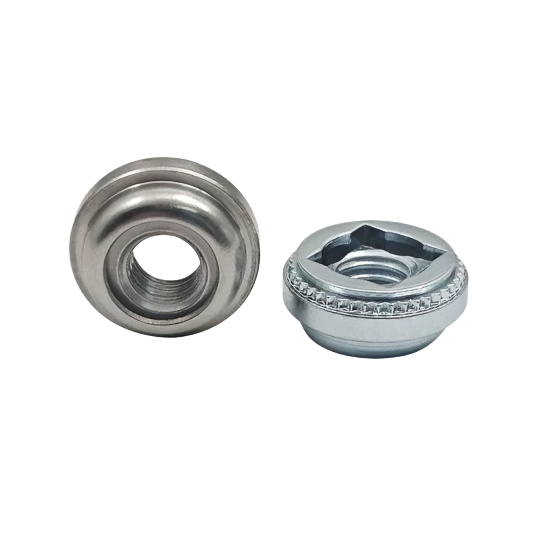
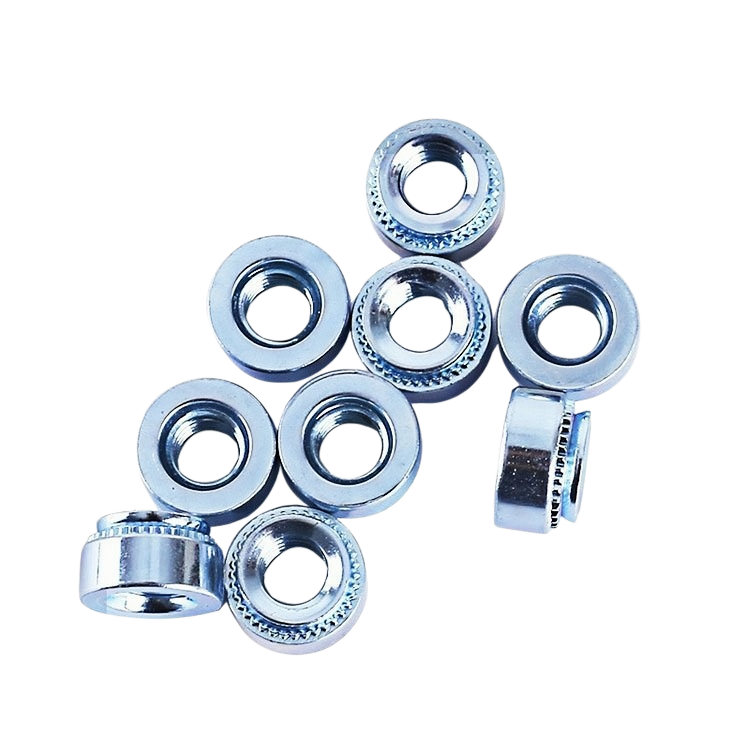
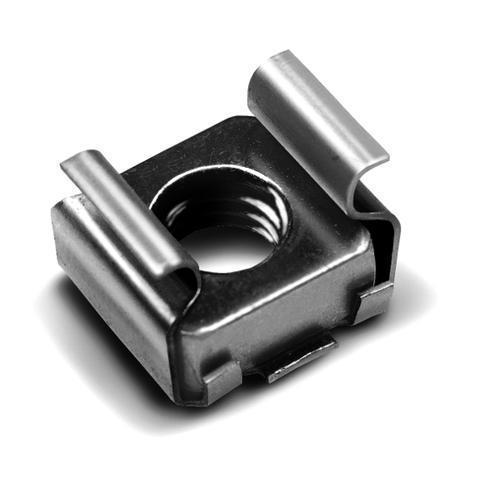
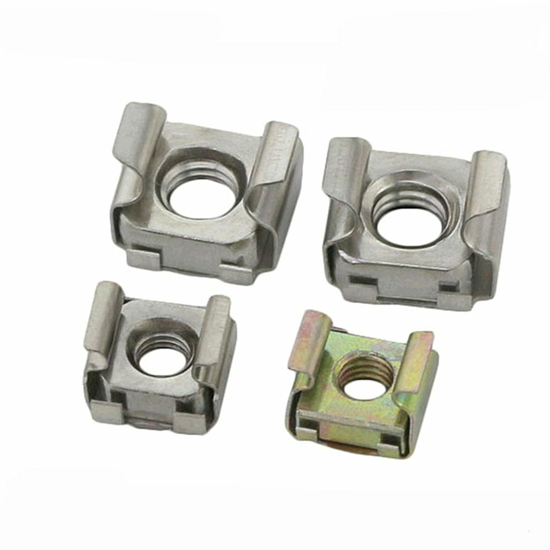
Self-clinching nuts, also known as clinch nuts or press-in nuts, are specialized fasteners designed to provide strong, load-bearing threads in sheet metal that is too thin to be conventionally tapped. Unlike weld nuts or traditional nuts, they are installed by pressing them into a pre-punched or drilled hole using a parallel squeezing force, which causes the surrounding parent material to cold‑flow into a specially designed undercut and serrations on the nut. This creates a permanent, flush‑mount fastening point with high push‑out and torque‑out resistance, without requiring access to the back side of the panel for installation.
Available Types – By Material Series
The most fundamental classification of self‑clinching nuts is based on material and the sheet hardness they can accommodate. The following four series form the core of the product line:
| Series | Material | Recommended Sheet Material | Sheet Hardness Limit | Description |
|---|---|---|---|---|
| S / SS | Heat‑Treated Carbon Steel (S) / Stainless Steel (SS) | Steel or Aluminum | HRB 80 / HB 150 or less | Highest strength carbon steel option; SS provides stainless corrosion resistance. Provides high pushout and torque‑out resistance for load‑bearing threads in thin sheets |
| CLS / CLSS | 300 Series Stainless Steel | Steel or Aluminum | HRB 70 / HB 125 or less | Standard stainless steel self‑clinching nut. Excellent corrosion resistance with high pushout and torque‑out performance. Most widely used for general applications requiring stainless steel |
| CLA | Aluminum / Copper | Steel or Aluminum | HRB 50 / HB 82 or less | Lightweight option with good conductivity. Compatible with anodized aluminum sheets. Non‑magnetic. Ideal for weight‑sensitive applications |
Additional Functional Types
The material series above serve as the foundation. The following functional variants are built upon them to address specific application needs:
| Functional Type | Corresponding PEM Series | Base Material Series | Description |
|---|---|---|---|
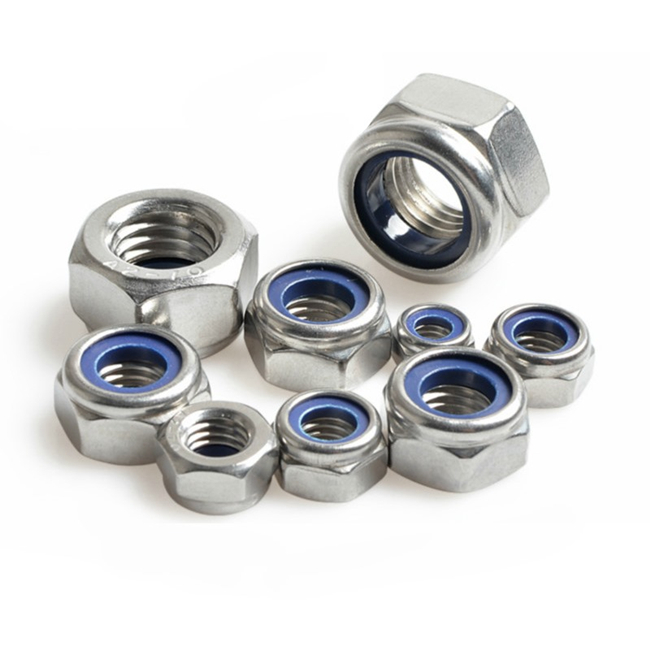
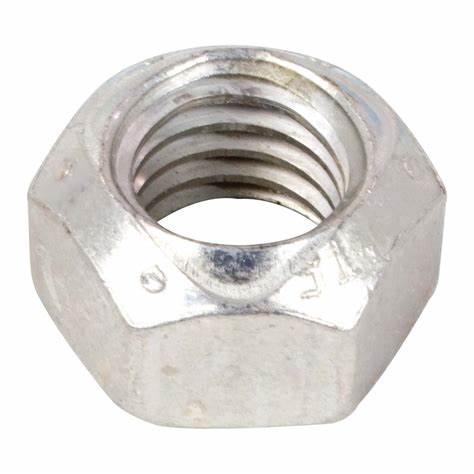
| Self‑Locking | FE / FEO / UL / LK / LKS / SL | S/SS, CLS/CLSS | Prevailing torque design (nylon insert or all‑metal PEMFLEX®). Meets NASM25027 locking torque requirements. Ideal for high‑vibration applications |
| Floating | A4 / AS / LA4 / LAS / AC / LAC | S/SS, CLS/CLSS | Allows up to 0.030″ radial misalignment to compensate for mating hole mismatch. Self‑locking versions available (LA4, LAS, LAC) |
| Blind | B / BS | S/SS, CLS/CLSS | Closed‑end design prevents screw penetration and seals out foreign materials. Ideal for electronics enclosures and contamination‑sensitive assemblies |
| Countersunk Head | CLA / CLS / CLSS | CLS/CLSS, CLA | Low‑profile head for flush mounting in thin sheets where protrusion is not permitted |
| Miniature | U / UL / FE / FEO | S/SS, CLS/CLSS | Ultra‑small design for space‑constrained applications. Self‑locking versions (UL, FE, FEO) available |
Applicable Standards
Unlike standard hex nuts, self‑clinching nuts do not have a unified ISO or DIN dimensional standard. The industry primarily follows PEM® brand specifications (PennEngineering), which serve as the de facto standard for dimensions and performance.
Materials & Surface Finishes
| Material | Grades / Types | Properties | Typical Applications |
|---|---|---|---|
| Carbon Steel | Case‑hardened mild steel, zinc plated per BS3382 | High strength, good corrosion resistance, cost‑effective | General industrial, white goods, automotive |
| Stainless Steel | 300 Series (304, 316); A286 for SP series | Excellent corrosion resistance, non‑magnetic | Medical equipment, marine, food processing, aerospace |
| Aluminum | 6061, 7075 (typically) | Lightweight, good corrosion resistance | Aerospace, portable electronics, weight‑sensitive applications |
Surface Finishes
-
Zinc Plating (clear, yellow) – carbon steel
-
Passivation – stainless steel
-
Plain / as‑formed – aluminum
Common Applications
| Industry | Specific Applications |
|---|---|
| Aerospace | Aircraft seat mounting, avionics enclosures, access panels, structural attachments |
| Automotive | Dashboard components, seat belt mounts, engine control modules, body panels |
| Electronics | Server racks, telecommunications equipment, computer chassis, audio equipment |
| Medical | Diagnostic equipment, imaging systems, surgical instruments, hospital furniture |
| Industrial | Control panels, HVAC equipment, heavy machinery enclosures, white goods (appliances) |
| Telecommunications | Base station enclosures, antenna mounts, cabinet hardware |



 No products in the cart.