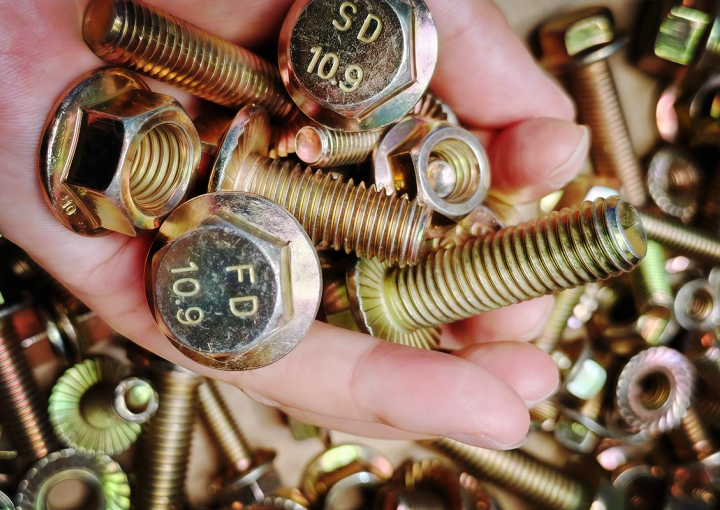
When Class 8.8 bolts reach their strength limit, engineers turn to Class 10.9 bolts. These high-strength metric fasteners represent the next tier in ISO 898-1 property classes — delivering 25% higher tensile strength than 8.8 and forming the backbone of automotive powertrains, structural steel connections, and heavy machinery.
But what exactly does “Class 10.9” mean? How much stronger is it than 8.8? What materials are used? And when should you specify it over the alternatives?
This article provides a complete guide to Class 10.9 bolts — also widely known as Grade 10.9 bolts — covering the meaning of the numbers, mechanical properties, material composition and applications.
What Does Class 10.9 Mean? Decoding the Numbers
Metric bolt strength grades follow a simple two-number system standardized under ISO 898-1:2013. The numbers are not arbitrary — they directly tell you the bolt’s strength:
| Part of the marking | Calculation | Result |
|---|---|---|
| First number (10) | × 100 = Minimum ultimate tensile strength | 1,000 MPa |
| First number × second number (10 × 9) | × 10 = Minimum yield strength | 900 MPa |
Thus, a Class 10.9 bolt (or Grade 10.9 bolt) has:
-
Minimum tensile strength: 1,000 MPa (megapascals)
-
Minimum yield strength: 900 MPa (90% of tensile)
-
Elongation after fracture: 9% minimum
The “.9” indicates that the yield strength is 90% of the tensile strength — higher than 8.8‘s 80%, meaning 10.9 bolts are more brittle but significantly stronger.
The two numbers are always stamped on the bolt head. Metric 10.9 bolts are easy to spot because the numbers “10.9” are typically embossed directly on the head.
Terminology note: In ISO standards, the correct term is “Class 10.9” . In North American markets, you may see “Grade 10.9 bolt” used interchangeably — both refer to the same specification.
Mechanical Properties of Class 10.9 Bolts
Per ISO 898-1:2013, the mechanical requirements for Class 10.9 bolts are:
| Property | Requirement |
|---|---|
| Tensile strength (Rm), min | 1,000 MPa (1,040 MPa for some diameters) |
| Yield strength (Rp0.2), min | 900 MPa (940 MPa for some diameters) |
| Proof load stress (Sp), nominal | 830 MPa |
| Elongation after fracture (A), min | 9% |
| Reduction of area (Z), min | 48% |
| Hardness (HV) | 320–380 HV |
| Hardness (HRC) | 32–39 HRC |
| Proof strength ratio | 0.88–0.90 |
Material Composition and Heat Treatment
Class 10.9 bolts require stricter material controls than Class 8.8. They can be made from two main material types:
Type 1: Medium Carbon Alloy Steel
This is the traditional material for Class 10.9 bolts. Typical composition includes:
-
Carbon (C): 0.30–0.50%
-
Manganese (Mn): 0.60% minimum
-
Chromium (Cr): 0.30% minimum (for hardenability)
-
Phosphorus (P) / Sulfur (S): ≤ 0.025% each
ASTM A490M (metric high-strength structural bolt standard) specifies Type 1 — medium carbon alloy steel for Class 10.9 structural bolts, quenched and tempered to achieve tensile strength of 1,040 to 1,210 MPa.
Type 2: Low Carbon Boron Steel (Alternative)
A more recent development for cost-sensitive applications is low carbon boron steel. Research shows that when a low carbon boron steel bolt is used as a Class 10.9 bolt under high stress, delayed fracture may occur — so careful control of phosphorus and sulfur levels is essential.
Through the development of new low carbon boron steel with increased delayed fracture strength, Class 10.9 bolts can be applied to body and chassis applications with lower cost while maintaining the same level of performance compared to conventional SCM435.
Heat Treatment
Class 10.9 bolts must be quenched and tempered (through-hardened). The tempering temperature range is typically 340–425°C — lower than for 8.8 bolts, resulting in higher hardness but reduced ductility.
Class 10.9 vs. Class 8.8: Side-by-Side Comparison
| Property | Class 8.8 | Class 10.9 | Difference |
|---|---|---|---|
| Tensile strength | 800 MPa | 1,000 MPa | +25% |
| Yield strength | 640 MPa | 900 MPa | +40% |
| Elongation | 12% | 9% | -25% |
| Hardness (HRC) | 22–32 | 32–39 | Harder |
| Material | Medium carbon steel | Alloy steel or low-carbon boron | Higher cost |
| Ductility | Higher | Lower | More brittle |
| Relative cost | Baseline (1×) | 1.3–1.5× | Moderate premium |
Key takeaway: Class 10.9 delivers 40% higher yield strength than Class 8.8 but with reduced ductility (9% vs. 12% elongation). It is the preferred choice for high-stress applications where 8.8 is insufficient — but it requires more careful assembly and stricter quality control.
Class 10.9 vs. SAE Grade 8 (Imperial)
For those familiar with imperial fasteners, here’s how Class 10.9 compares to SAE Grade 8:
| Aspect | Metric Class 10.9 | SAE Grade 8 (imperial) |
|---|---|---|
| Tensile strength | 1,000 MPa (145,000 psi) | 150,000 psi (approx. 1,034 MPa) |
| Yield strength | 900 MPa (130,500 psi) | 130,000 psi (approx. 896 MPa) |
| Equivalent | Nearly identical | Nearly identical |
SAE Grade 8 bolts are manufactured from medium-carbon alloy steel, undergo quenching and tempering, and are identified by six radial lines on the head.Metric Class 10.9 bolts are essentially the international equivalent of Grade 8. For all practical engineering purposes, they occupy the same performance tier.
The primary reason to choose one over the other is dictated by the origin of the machinery — European or Asian-made equipment will almost exclusively use Class 10.9, while older or US-specific equipment may still utilize Grade 8.
Typical Applications for Class 10.9 Bolts
Class 10.9 bolts are specified wherever higher strength than 8.8 is required:
| Industry | Typical Applications |
|---|---|
| Automotive powertrain | Engine components, transmission mounting, connecting rods, cylinder heads |
| Automotive chassis & suspension | Suspension systems, steering knuckles, axle assemblies, wheel hub bolts |
| Structural steel connections | Building frames, bridge connections, wind turbine towers |
| Heavy machinery | Construction equipment, mining machinery, excavators, bulldozers |
| Valves, pumps, motors | High-stress fluid handling equipment |
| Agricultural equipment | Tractors, harvesters, implements requiring higher strength |
| Railway equipment | Track fastening, rolling stock assembly |
Torque Guidelines for Class 10.9 Bolts
Proper tightening torque is essential to achieve the desired clamping force without over-stressing the bolt. Below are recommended torque values for lubricated Class 10.9 bolts:
| Thread Size | Recommended Torque (Nm) |
|---|---|
| M6 | ~14 |
| M8 | ~33 |
| M10 | ~65 |
| M12 | ~114 |
| M16 | ~277 |
| M20 | ~541 |
| M24 | ~930 |
Note: Actual torque depends on lubrication, thread condition, and joint design. Always verify with engineering calculations.
How to Identify Class 10.9 Bolts
Class 10.9 bolts are identified by the marking “10.9” stamped on the bolt head. The marking is usually raised or indented, and may include a manufacturer’s symbol.
Example head marking:
10.9 or 10.9 with a logo
Do not rely on color or surface finish — plating can vary (zinc, black oxide, Dacromet, etc.). Always check the head stamp.
Matching Nuts for Class 10.9 Bolts
Per ISO 898-2, a Class 10 nut (or higher) should be used with a Class 10.9 bolt. Using a lower-strength nut risks thread stripping before the bolt reaches its full capacity.
| Bolt Grade | Recommended Nut Grade |
|---|---|
| Class 8.8 | Class 8 (or 10, 12) |
| Class 10.9 | Class 10 (or 12) |
| Class 12.9 | Class 12 |
Summary: Class 10.9 Bolts at a Glance
| Aspect | Specification |
|---|---|
| Standard | ISO 898-1:2013 |
| Tensile strength (min) | 1,000 MPa (1,040 MPa for some sizes) |
| Yield strength (min) | 900 MPa (940 MPa for some sizes) |
| Elongation (min) | 9% |
| Hardness range | 32–39 HRC (320–380 HV) |
| Material | Alloy steel (medium carbon Cr-Mo) or low-carbon boron steel |
| Heat treatment | Quenched and tempered (340–425°C) |
| Matching nut | Class 10 |
| SAE equivalent | Grade 8 |
| Relative cost | 1.3–1.5× Class 8.8 |
| Key advantage | 40% higher yield strength than 8.8 |
| Key risk | Hydrogen embrittlement susceptibility |
| Primary applications | Automotive powertrain/chassis, structural steel, heavy machinery |
Frequently Asked Questions
Q: Is “Class 10.9” the same as “Grade 10.9”?
A: Yes. “Class” is the ISO term, but “Grade” is widely used in North America. They refer to the same specification.
Q: How much stronger is 10.9 than 8.8?
A: 25% higher tensile strength (1,000 vs. 800 MPa) and 40% higher yield strength (900 vs. 640 MPa).
Q: Can I use Class 10.9 bolts outdoors?
A: Yes, but the surface finish matters. Standard zinc plating may not be sufficient — specify a corrosion-resistant finish such as Dacromet, Geomet, or properly controlled hot-dip galvanizing. Caution: Hot-dip galvanizing of 10.9 bolts carries hydrogen embrittlement risk unless special precautions are taken.
Q: Are Class 10.9 bolts brittle?
A: More brittle than 8.8 (9% elongation vs. 12%), but still ductile enough for most high-strength applications. They require more careful assembly and torque control than 8.8.
Q: What is the SAE equivalent of Class 10.9?
A: SAE Grade 8. They are nearly identical in strength and occupy the same performance tier.
 No products in the cart.