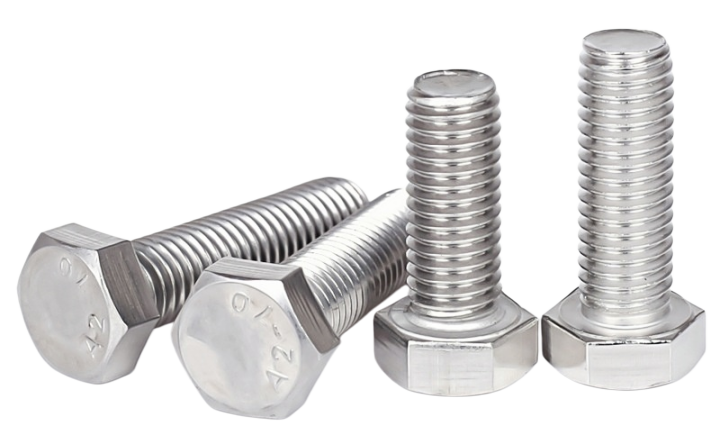
When you specify stainless steel fasteners, you’ll encounter three designations more often than any others: A2-70, A4-70, and A4-80.
They look similar. They all come from austenitic stainless steel families. But the differences between them—in corrosion resistance, strength, and cost—can make or break a bolted connection in marine environments, chemical plants, or structural applications.
This article provides a complete side‑by‑side comparison of these three grades, covering chemical composition, mechanical properties, corrosion resistance, and application guidance.
How to Read the Designation
Before comparing the grades, it’s helpful to understand what “A2‑70” and “A4‑80” actually mean.
| Part of the code | What it indicates |
|---|---|
| A | Austenitic stainless steel (the most common stainless steel family for fasteners) |
| 2 or 4 | Material group: A2 = 304 series; A4 = 316 series (with molybdenum) |
| 70 or 80 | Minimum tensile strength in hundreds of MPa (70 = 700 MPa, 80 = 800 MPa) |
Chemical Composition
The essential difference between A2 and A4 lies in the alloying elements. A4 contains molybdenum (Mo), which dramatically improves resistance to chlorides and pitting corrosion.
| Element | A2‑70 (304) | A4‑70 / A4‑80 (316) |
|---|---|---|
| Chromium (Cr) | 18–20% | 16–18.5% |
| Nickel (Ni) | 8–10.5% | 10–14% |
| Molybdenum (Mo) | — | 2.0–3.0% |
| Carbon (C) | ≤0.08% | ≤0.08% |
| Silicon (Si) | ≤1.00% | ≤1.00% |
| Manganese (Mn) | ≤2.00% | ≤2.00% |
| Phosphorus (P) | ≤0.045% | ≤0.045% |
| Sulfur (S) | ≤0.030% | ≤0.030% |
Reference: A2 corresponds to grade 1.4301 (304); A4 corresponds to grade 1.4401 (316) with 2–3% molybdenum. A4‑80 bolts are generally made from 316 or 316L stainless steel.
Mechanical Properties at a Glance
| Property | A2‑70 | A4‑70 | A4‑80 |
|---|---|---|---|
| Minimum tensile strength (Rm) | 700 MPa | 700 MPa | 800 MPa |
| Minimum yield strength (Rp0.2) | 450 MPa | 450 MPa | 600 MPa |
| Elongation (A) | 40% (typical) | 40% (typical) | 30% (typical) |
| Hardness | 95–215 HB | 95–215 HB | 160–220 HB |
A4‑80 fasteners are made from severely hard cold drawn bar, giving them mechanical properties similar to carbon steel grade 8.8 bolts.
Summary of Mechanical Differences
| Strength aspect | A2‑70 / A4‑70 | A4‑80 |
|---|---|---|
| Tensile strength | 700 MPa | 800 MPa (+14%) |
| Yield strength | 450 MPa | 600 MPa (+33%) |
| Ductility | Higher (40%) | Moderate (30%) |
Corrosion Resistance Comparison
A2 (304) – General Purpose
A2 stainless steel offers good corrosion resistance for most indoor and mild outdoor environments. It resists oxidation and mild chemicals but is not recommended for salt‑water, marine, or coastal applications where chloride exposure is significant.
A4 (316) – Enhanced Corrosion Resistance
The addition of 2–3% molybdenum gives A4 stainless steel much higher resistance to pitting and crevice corrosion. A4 is rated for corrosion class C5 (very high corrosivity), whereas A2 is typically rated C4 (high).
Comparison summary:
| Environment | Recommended grade |
|---|---|
| Indoor, dry | A2‑70 |
| Outdoor, moderate | A2‑70 or A4‑70 |
| Coastal, marine | A4‑70 or A4‑80 |
| Chemical exposure | A4‑70 or A4‑80 |
| Salt water immersion | A4‑80 (with adequate strength) |
How Strength Is Achieved: Cold Working vs. Heat Treatment
Unlike carbon steel bolts (which are quenched and tempered), austenitic stainless steel fasteners cannot be strengthened by heat treatment. Instead, their strength comes entirely from cold working (also called work hardening or strain hardening).
-
A2‑70 and A4‑70 are produced from cold‑drawn bar and achieve 700 MPa tensile strength through moderate cold work.
-
A4‑80 is produced from severely cold‑drawn bar, undergoing greater plastic deformation to reach 800 MPa tensile strength.
Because A4‑80 requires more severe cold working, it is less available and typically more expensive than A4‑70. Many suppliers stock A4‑70 more readily, while A4‑80 is often made to order.
Practical implication: If your project requires A4‑80, check availability and lead times early. For many applications, A4‑70 provides an excellent balance of corrosion resistance and strength at lower cost and with better availability.
A4‑70 vs. A4‑80: A Closer Look
The choice between A4‑70 and A4‑80 often comes down to strength requirements versus availability.
| Aspect | A4‑70 | A4‑80 |
|---|---|---|
| Tensile strength | 700 MPa | 800 MPa |
| Yield strength | 450 MPa | 600 MPa |
| Elongation | ~40% | ~30% |
| Cold work intensity | Moderate | Severe |
| Availability | Widely stocked | Less common; often special order |
| Cost | Lower | Higher |
| Typical applications | General marine, chemical, structural | High‑load marine, offshore, heavy equipment |
Guidance:
-
For most marine and chemical applications, A4‑70 is sufficient and more economical.
-
For higher strength requirements where A4‑70 is inadequate, A4‑80 is the appropriate choice—but verify availability and cost premiums.
-
For applications requiring both high strength and extreme corrosion resistance, consider duplex stainless steel grades (e.g., A5‑80) which offer even higher strength and better chloride resistance.
Application Summary Table
| Application environment | Recommended grade | Rationale |
|---|---|---|
| Indoor, dry, light duty | A2‑70 | Lowest cost, adequate corrosion resistance |
| Outdoor, moderate atmosphere | A2‑70 or A4‑70 | A2 is usually sufficient; A4 provides extra safety margin |
| Coastal / marine (above water) | A4‑70 | Molybdenum content resists chloride‑induced pitting |
| Marine (splash zone or immersion) | A4‑80 (or duplex) | Higher strength + maximum pitting resistance |
| Chemical plants (non‑chloride) | A2‑70 or A4‑70 | Both resist most industrial chemicals |
| Chemical plants (chloride‑containing) | A4‑70 or A4‑80 | Molybdenum is essential |
| Structural connections with high load | A4‑80 | Higher strength (800 MPa vs. 700 MPa) |
| Food processing | A4‑70 | 316 provides excellent sanitation and corrosion resistance |
| Swimming pools / wastewater | A4‑70 | Chlorine and chlorides require A4 grade |
Quick Reference Card
| Grade | Material | Tensile (MPa) | Yield (MPa) | Corrosion resistance | Best for |
|---|---|---|---|---|---|
| A2‑70 | 304 | 700 | 450 | Good (C4) | General purpose, indoor, mild outdoor |
| A4‑70 | 316 | 700 | 450 | Very good (C5) | Marine, coastal, chemical, food |
| A4‑80 | 316 | 800 | 600 | Very good (C5) | High‑load marine, offshore, heavy equipment |
Summary
-
A2‑70 is the workhorse general‑purpose stainless steel fastener, offering good corrosion resistance and 700 MPa tensile strength. It is suitable for most indoor and mild outdoor applications.
-
A4‑70 adds molybdenum for superior chloride resistance, making it the standard choice for marine, coastal, and chemical environments. It shares the same 700 MPa tensile strength as A2‑70.
-
A4‑80 is the high‑strength variant of A4, with 800 MPa tensile strength and 600 MPa yield strength. It is produced through severe cold working and is less commonly stocked.
When selecting a grade, consider both the corrosion environment (A2 vs. A4) and the mechanical load (70 vs. 80). For many projects, A4‑70 provides the optimal balance of corrosion resistance, strength, availability, and cost.
 No products in the cart.