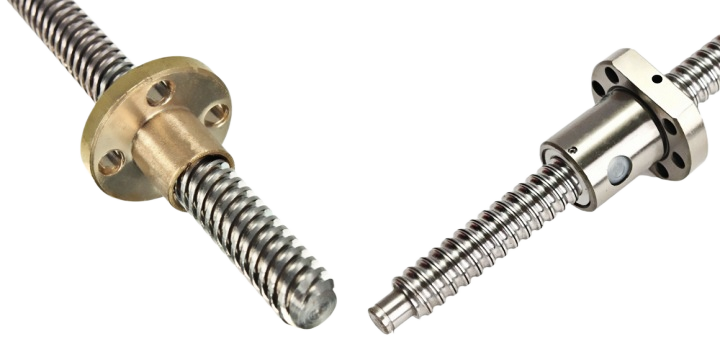
Lead screws and ball screws are both mechanical devices that convert rotary motion into linear motion. They are found in everything from 3D printers and medical devices to CNC machines and aircraft actuators. While they serve the same basic function, their internal working principles are fundamentally different — leading to major differences in efficiency, precision, cost, and application suitability.
What Is a Lead Screw?
A lead screw is a type of power screw that uses sliding friction between the screw shaft and the nut. The nut is typically made of bronze, plastic (e.g., acetal, PEEK), or a wear‑resistant polymer. As the screw rotates, the nut slides along the threads, generating linear motion.
The mating surfaces slide against each other, so friction is relatively high. This simple, robust design has been used for centuries — from early machine tools to modern actuators.
Common applications: 3D printer Z‑axes, laboratory jacks, linear actuators in medical equipment, valves, and low‑cost positioning systems.
What Is a Ball Screw?
A ball screw uses rolling friction instead of sliding friction. Recirculating balls run in the matching helical grooves of the screw shaft and the nut. When the screw rotates, the balls roll along the raceways, transferring the load with very little friction. At the ends of the nut, return tubes or deflectors guide the balls back to the starting point, enabling continuous recirculation.
Because the balls roll rather than slide, friction is dramatically reduced — typically to less than one‑tenth of a lead screw’s friction. This allows ball screws to achieve much higher speeds, longer life, and greater positional accuracy.
Common applications: CNC milling machines, industrial robots, electric vehicle steering systems, aerospace actuators, and semiconductor handling equipment.
Key Differences at a Glance
| Parameter | Lead Screw | Ball Screw |
|---|---|---|
| Working principle | Sliding friction | Rolling friction (recirculating balls) |
| Typical efficiency | 35–50% for Acme threads; up to 70% for square threads | 85–95% |
| Backlash | Moderate (can be reduced with anti‑backlash nuts) | Very low to zero (preload eliminates backlash) |
| Self‑locking capability | Yes for most designs (efficiency < 50%, helix angle < 4°–5°) | No (requires brake for vertical axes) |
| Maximum speed | Low to moderate: ≤ 0.3 m/s for plastic nuts; ≤ 0.5 m/s for bronze nuts | High (> 1.5 m/s common) |
| Lifetime | Limited primarily by nut wear (nut is usually the softer, replaceable component) | Long (fatigue of raceways; predictable service life per L10 rating) |
| Noise | Quiet | Higher (ball recirculation noise) |
| Sensitivity to contamination | Moderate: debris can embed into soft nut material, accelerating wear in dusty environments | High: dirt can damage raceways or block ball return paths |
| Maintenance | Low – some self‑lubricating nuts require no external lube | Regular lubrication required (grease or oil) |
| Relative cost | Low to moderate | Moderate to high (2–5× lead screw) |
Deeper Technical Comparison
Efficiency and Heat
A ball screw typically achieves 90% or higher efficiency. Only about 10% of input torque is lost to friction. In contrast, a common Acme lead screw may waste 50–65% of torque as heat. For battery‑powered or energy‑sensitive applications, the ball screw’s efficiency is a major advantage. For low‑duty, intermittent motion, the lost energy of a lead screw is often acceptable.
Backlash and Precision
Lead screws inherently have clearance between the screw and nut threads — otherwise they would bind. This clearance creates backlash (lost motion when reversing direction). Anti‑backlash nuts (split nuts or spring‑loaded nuts) can reduce backlash to a few microns, but they add cost and may wear faster.
Ball screws can be preloaded by using double nuts (with a spacer or thread adjustment) or a variable‑lead single nut (where the lead changes slightly in the middle section). These methods eliminate backlash entirely, providing excellent repeatability (often ±0.005 mm or better). For precision positioning — such as CNC machining or wafer handling — ball screws are the standard.
Self‑locking (Backdrivability)
One of the most important practical differences: lead screws are self‑locking (non‑backdrivable) when the efficiency is below approximately 50%. For typical Acme threads, this corresponds to a helix angle smaller than about 4°–5°. Under these conditions, a vertical load cannot spin the screw backwards, so the position holds without a brake.
Ball screws are backdrivable — a vertical load will push the nut down, rotating the screw. Therefore, vertical ball screw axes must have a holding brake or a counterweight.
This self‑locking property of lead screws makes them the default choice for vertical applications like 3D printer Z‑axes, lifting tables, and hospital beds.
Life and Wear
Ball screw life is calculated by fatigue failure of the raceways (L10 life, similar to bearings). Properly lubricated and protected from contamination, ball screws can run millions of cycles.
Lead screw life is limited primarily by wear of the nut threads, since the nut is usually made of a softer, sacrificial material that can be economically replaced. Under clean, well‑lubricated conditions, lead screws can still achieve long service life — but under high load, high speed, or in abrasive environments, wear accelerates. For heavy‑duty, continuous operation, ball screws are superior.
Application Guide
| Application | Recommended | Why |
|---|---|---|
| 3D printer Z‑axis | Lead screw | Vertical axis needs self‑locking; low speed; cost sensitive |
| CNC mill X‑Y axes | Ball screw | High speed, high precision, frequent reversals, high load |
| Medical infusion pump | Lead screw | Low noise, low speed, moderate precision, can be self‑lubricating |
| Industrial robot arm | Ball screw | High load, high duty cycle, long life, precision |
| Electric linear actuator (low cost) | Lead screw | Simple, robust, no brake required for vertical use |
| High‑speed pick‑and‑place | Ball screw | Fast acceleration, long life, low friction |
| Vacuum environment (e.g., semiconductor) | Lead screw (with special polymer nut) | No lubricant outgassing; ball screw grease may be prohibited |
Selection Checklist
When choosing between a lead screw and a ball screw, ask these questions:
-
Is the axis vertical?
-
Yes → Lead screw often wins (self‑locking). If ball screw is chosen, a brake is mandatory.
-
-
What duty cycle?
-
Continuous or high frequency → Ball screw (better wear life, heat dissipation).
-
Occasional, low duty → Lead screw (cost effective).
-
-
Required positional accuracy / backlash tolerance?
-
Zero backlash essential → Ball screw (preloaded).
-
A few tenths of a millimeter acceptable → Lead screw with anti‑backlash nut.
-
-
Maximum speed?
-
0.5 m/s → Ball screw.
-
< 0.2 m/s → Lead screw acceptable.
-
-
Environmental concerns?
-
Abrasive dust or lack of maintenance → Lead screw (less sensitive to contamination, but nut wear may increase).
-
Clean, controlled environment → Ball screw.
-
-
Cost constraint?
-
Low budget → Lead screw.
-
Performance justifies higher cost → Ball screw.
-
Summary
| Criterion | Lead Screw | Ball Screw |
|---|---|---|
| Best for | Low speed, vertical axes, intermittent duty, cost‑sensitive, quiet operation | High speed, high precision, high load, long life, frequent motion |
| Efficiency | Low–moderate | High |
| Self‑locking | Yes (most designs) | No |
| Backlash | Present (can be reduced) | Eliminable (preload) |
| Typical lifetime | Wear‑limited (nut replaceable) | Fatigue‑limited (predictable) |
| Price | $ | $$–$$$ |
Both technologies remain essential. Lead screws are not obsolete — they excel in applications where their unique self‑locking property and low cost outweigh efficiency disadvantages. Ball screws dominate where performance cannot be compromised.
 No products in the cart.