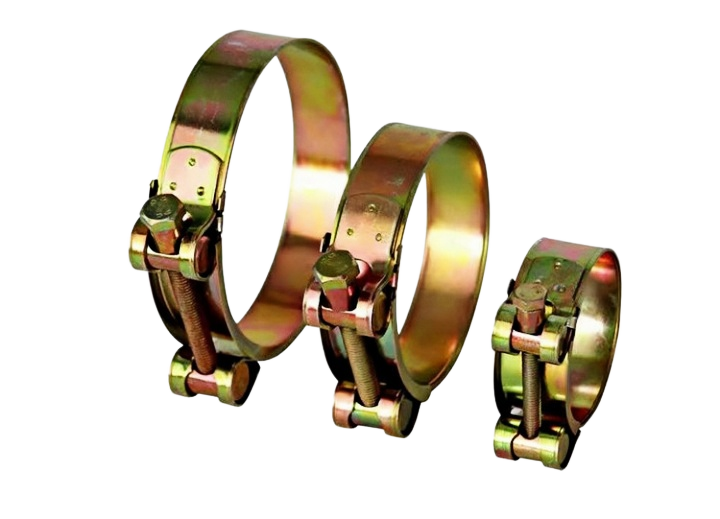
A T‑bolt hose clamp is a heavy‑duty clamping device designed to secure hoses onto fittings or pipes under demanding conditions. It is defined in DIN 3017‑3, which is the part of the DIN 3017 standard family specifically covering bolt clamps (Spannschrauben‑Schellen). Unlike worm‑gear clamps that rely on a perforated band and threaded screw, T‑bolt clamps use a separate bolt and nut mechanism acting on a solid bridgepiece, generating significantly higher clamping forces. This makes them the default choice for high‑pressure, suction, and industrial hose connections where reliability is paramount.
DIN 3017‑3 specifies two shape variants:
-
Shape C1: Standard T‑bolt clamp, the most widely used configuration.
-
Shape C2: Heavy‑duty T‑bolt clamp with reinforced components for extreme applications.
Basic Structure
A T‑bolt hose clamp per DIN 3017‑3 consists of four main components:
| Component | Function | Material Options |
|---|---|---|
| Band (Strap) | Wraps around the hose and transmits the clamping force evenly around the circumference | Steel (W1), stainless steel 430 (W2/W3), 304 (W4), 316 (W5) |
| T‑Bolt | The tensioning element; its T‑shaped head engages with the housing to pull the band tight | Carbon steel (W1/W2), A2‑70 (W4), A4‑70 (W5) |
| Bridgepiece (Housing) | A solid metal bridge that distributes bolt tension evenly and protects the hose from direct bolt contact | Same material group as the band |
| Hex Nut | Drives the bolt; standard hex allows tightening with common wrenches or sockets | Matched to bolt material grade |
A distinctive design feature is the solid bridgepiece, which arches over the joint area where the two ends of the band meet. Unlike worm‑drive clamps where the screw mechanism contacts and often damages the hose surface, the bridgepiece shields the hose while allowing the band to slide smoothly during tightening. This is particularly important for soft‑walled, rubber, and silicone hoses.
A rolled or rounded band edge is another key detail: DIN 3017‑3 clamps are typically manufactured with burr‑free, softened edges to prevent cutting into the hose jacket during installation and service.
Typical Applications
| Industry | Applications |
|---|---|
| Industrial Machinery | Coolant lines, air intake systems, dust extraction, hydraulic return lines |
| Marine & Shipbuilding | Bilge and ballast lines, fuel transfer hoses, exhaust bellows, seawater cooling |
| Food & Beverage | Sanitary hose connections, ingredient transfer, CIP systems (W4/W5) |
| Water & Wastewater | Sludge transfer, chemical dosing lines, aeration hoses, submersible pump connections |
| Agriculture | Fertilizer and slurry handling, irrigation systems, sprayer lines |
| Chemical Processing | Acid and solvent transfer, corrosive media (W5) |
| Pharmaceuticals | Clean utility hoses, purified water lines, sterile connections |
| Construction & Mining | Slurry hoses, dewatering pumps, dust control systems |
| Automotive & Heavy Vehicles | Turbocharger air hoses, intercooler connections, radiator hoses |
Materials per DIN 3017‑4
The material grades for DIN 3017‑3 clamps are defined in DIN 3017‑4 (Technical delivery conditions) and are designated by the W‑classification:
| Material Grade | Band & Bridgepiece | Bolt & Nut | Corrosion Resistance | Typical Applications |
|---|---|---|---|---|
| W1 | Carbon steel, zinc‑plated | Carbon steel, zinc‑plated | Low | Dry indoor industrial environments |
| W2 | Stainless steel 1.4016 (430) | Carbon steel, zinc‑plated | Moderate | General outdoor, cost‑sensitive applications requiring some corrosion resistance |
| W3 | Stainless steel 1.4016 (430) | Stainless steel 1.4016 (430) | Good | Outdoor structures, food equipment (non‑critical) |
| W4 | Stainless steel 1.4301 (304) | Stainless steel A2‑70 | High | Food and beverage, pharmaceutical, chemical plant, water treatment |
| W5 | Stainless steel 1.4401 (316) | Stainless steel A4‑70 | Very high | Marine, offshore, acid environments, wastewater treatment |
W5 — The Marine Grade
For the most demanding conditions, W5 clamps use full 316 stainless steel throughout. The molybdenum addition in 316 (compared to 304) provides superior resistance to pitting and crevice corrosion in chloride‑rich environments. W5 is the standard choice for seawater‑exposed systems, chemical processing, and any application where corrosion‑induced failure presents a safety or environmental risk.
Dimensional Reference
T‑bolt clamps under DIN 3017‑3 are specified by their clamping diameter range (e.g., 17–19 mm) and band width (e.g., 18 mm). A typical designation reads: T‑Bolt Hose Clamp DIN 3017‑3 — C1 — 17‑19/18 — W4
This translates to:
-
Standard: DIN 3017‑3 (bolt clamp)
-
Shape: C1 (standard T‑bolt design)
-
Clamping range: 17 mm to 19 mm
-
Band width: 18 mm
-
Material: W4 (304 stainless steel)
Applicable Standards Summary
| Standard | Scope |
|---|---|
| DIN 3017‑1 | Worm‑drive hose clamps (Shape A, B) |
| DIN 3017‑2 | Clamps with tightening ears (Shape B1, B2) |
| DIN 3017‑3 | Bolt clamps — T‑bolt design (Shape C1, C2) |
| DIN 3017‑4 | Technical delivery conditions — material grades, testing, marking |
| DIN 3017‑5 | Wide‑band clamps (Shape D, E) |
Selection Checklist
When specifying a T‑bolt hose clamp, consider these key points:
-
Hose diameter range: The actual installed diameter must fall within the clamp’s specified range.
-
Band width: Wider bands distribute clamping force better and suit softer hoses.
-
Material grade: Match the W‑grade to the environmental conditions (indoor W1, outdoor W2, food W4, marine W5).
-
Hose type: Soft rubber and silicone hoses benefit from the bridgepiece protection; harder hoses may tolerate simpler clamp designs.
-
Pressure rating: Ensure the clamp’s load capacity matches the system’s operating pressure.
T‑bolt hose clamps per DIN 3017‑3 deliver the reliability and robustness required by heavy‑duty industrial applications. Their combination of a protective bridgepiece, high clamping force, and availability in multiple corrosion‑resistant material grades makes them the preferred choice where failure is not an option.

 No products in the cart.