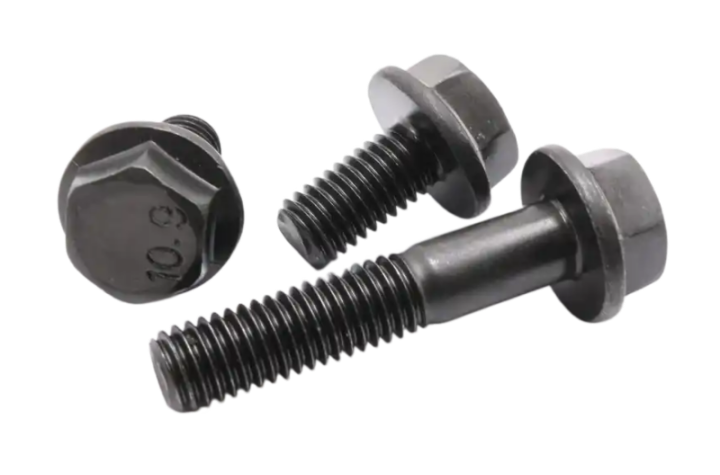
When engineers search for high-strength bolts or high-tensile bolts, they typically mean metric property classes 8.8, 10.9, and 12.9 — the three most common grades of quenched and tempered steel bolts defined by ISO 898-1. Choosing the right grade can mean the difference between a secure, long-lasting joint and a sudden, catastrophic failure.
This article provides a side-by-side comparison of Class 8.8, Class 10.9, and Class 12.9 high-strength bolts — covering mechanical properties, materials, applications and cost etc. Whether you’re specifying fasteners for automotive assemblies, structural steel, or heavy machinery, this guide will help you make an informed decision.
What Makes a Bolt “High-Strength” or “High-Tensile”?
In the fastener industry, high-strength bolts and high-tensile bolts are terms used interchangeably to describe bolts that have been quenched and tempered (heat-treated) to achieve tensile strengths of 800 MPa or higher.
The metric strength classification system (ISO 898-1) uses a two‑number code on the bolt head:
-
First number × 100 = minimum tensile strength (MPa)
-
First number × second number × 10 = minimum yield strength (MPa)
| Grade | Tensile Strength (min) | Yield Strength (min) | Common Name |
|---|---|---|---|
| 8.8 | 800 MPa | 640 MPa | High-strength (entry level) |
| 10.9 | 1,000 MPa | 900 MPa | High-tensile (automotive/structural) |
| 12.9 | 1,200 MPa | 1,080 MPa | Ultra-high-strength |
Grades below 8.8 (e.g., 4.6, 4.8, 5.6, 5.8, 6.8) are considered low or medium strength and are not heat‑treated.
Mechanical Properties at a Glance
The table below summarizes the key mechanical differences between the three high-strength grades per ISO 898‑1:2013:
| Property | Class 8.8 | Class 10.9 | Class 12.9 |
|---|---|---|---|
| Tensile strength (min) | 800 MPa | 1,000 MPa | 1,220 MPa |
| Yield strength (min) | 640 MPa | 900 MPa | 1,080 MPa |
| Yield / tensile ratio | 0.80 | 0.90 | 0.90 |
| Elongation after fracture (min) | 12% | 9% | 8% |
| Reduction of area (min) | 52% | 48% | 44% |
| Hardness (HRC) | 22–32 | 32–39 | 39–44 |
| Hardness (HV) | 250–335 | 320–380 | 385–435 |
Material Composition and Heat Treatment
| Grade | Material Type | Typical Alloys | Heat Treatment |
|---|---|---|---|
| 8.8 | Medium-carbon steel or boron‑treated carbon steel | 35#, 45#, ML35, SWRCH35K, 10B21 | Quenched & tempered (≥425°C temper) |
| 10.9 | Low-alloy steel or carbon steel with additives | 40Cr, 35CrMo, SCM435, 20MnTiB | Quenched & tempered (340–425°C temper) |
| 12.9 | Mandatory alloy steel | SCM435, 35CrMo, 42CrMo | Quenched & tempered (380–425°C temper) |
High-Strength Bolt Comparison: 8.8 vs 10.9 vs 12.9
| Aspect | Class 8.8 | Class 10.9 | Class 12.9 |
|---|---|---|---|
| Strength level | Medium‑high | High | Ultra‑high |
| Typical applications | General machinery, construction, agricultural equipment | Automotive powertrain, structural steel, heavy machinery | Aerospace, racing, high‑performance automotive, wind turbines |
| Ductility | Highest (12%) | Moderate (9%) | Lowest (8%) |
| Hydrogen embrittlement risk | Low | High | Very high |
| Electroplating suitability | Acceptable with baking | Caution required | Strongly discouraged |
| Recommended surface finish | Zinc, black oxide, Dacromet | Dacromet, Geomet, black oxide (avoid electroplating) | Zinc flake coatings (Geomet, Delta) |
| Relative cost | Baseline (1×) | 1.3–1.5× | 1.8–2.2× |
| SAE equivalent | Grade 5 | Grade 8 | No direct equivalent |
Torque Comparison (Lubricated)
| Thread Size | Class 8.8 (Nm) | Class 10.9 (Nm) | Class 12.9 (Nm) |
|---|---|---|---|
| M6 | ~10 | ~14 | ~17 |
| M8 | ~24 | ~33 | ~40 |
| M10 | ~47 | ~65 | ~79 |
| M12 | ~81 | ~114 | ~136 |
| M16 | ~197 | ~277 | ~333 |
| M20 | ~385 | ~541 | ~649 |
| M24 | ~665 | ~930 | ~1,120 |
Cost Considerations
| Grade | Relative Cost | Why |
|---|---|---|
| 8.8 | 1× (baseline) | Carbon steel with additives; simple heat treatment |
| 10.9 | 1.3–1.5× | Requires low-alloy steel or strict chemistry control; tighter heat treatment |
| 12.9 | 1.8–2.2× | Mandatory alloy steel (Cr-Mo); more precise heat treatment; lower yield in large diameters |
The cost jump from 10.9 to 12.9 is often larger than from 8.8 to 10.9 because 12.9 cannot use plain carbon steel — it must use expensive alloys like SCM435 or 42CrMo.
Summary Table: Choosing the Right High-Tensile Bolt
| Criterion | Class 8.8 | Class 10.9 | Class 12.9 |
|---|---|---|---|
| Tensile strength | 800 MPa | 1,000 MPa | 1,200 MPa |
| Yield strength | 640 MPa | 900 MPa | 1,080 MPa |
| Ductility | Best (12%) | Good (9%) | Limited (8%) |
| Cost | Lowest | Moderate | Highest |
| Hydrogen risk | Low | High | Very high |
| Best for | General machinery | Automotive, structural | Aerospace, racing, extreme loads |
| SAE equivalent | Grade 5 | Grade 8 | None |
 No products in the cart.