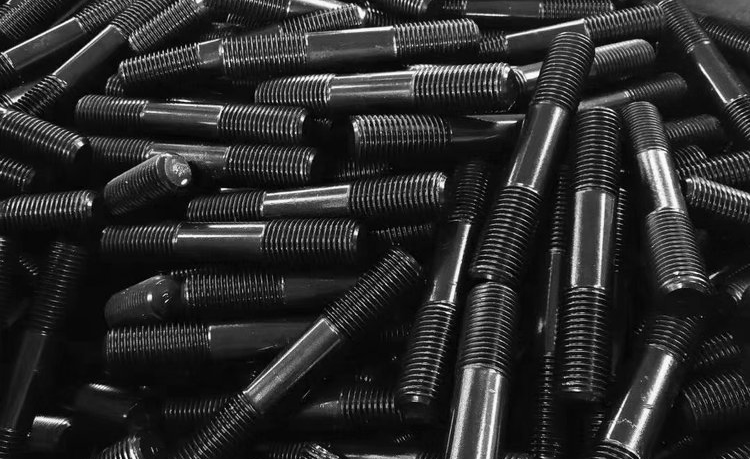
If zinc plating is the workhorse of fastener finishes, black oxide is the dress shoe—stylish, sleek, and perfectly suited for certain occasions, but not something you’d take hiking through the mud.
Black oxide (also called blackening or bluing) is one of the oldest surface treatments for steel fasteners. It’s instantly recognizable by its deep black or blue-black appearance, often seen on tools, firearms, and decorative hardware. But here’s what every buyer needs to understand: black oxide offers almost no corrosion protection by itself.
What Is Black Oxide?
Black oxide is a conversion coating, not a plating. Unlike zinc electroplating which deposits a layer of metal on the surface, black oxide chemically converts the surface of the steel itself into magnetite (Fe₃O₄)—a stable black iron oxide.
The result is an extremely thin coating, typically only 0.6–0.8 μm thick. To put that in perspective, conventional zinc plating is 5–12 μm thick—roughly 10 times thicker. This thinness is both the greatest advantage and the greatest limitation of black oxide.
Key Characteristics
| Property | Black Oxide | Zinc Plating (for comparison) |
|---|---|---|
| Coating thickness | 0.6–0.8 μm | 5–12 μm |
| Coating type | Conversion (chemically bonded) | Deposited layer |
| Corrosion protection | Minimal without oil | Moderate (24–200h salt spray) |
| Dimensional change | None—preserves tolerances | 5–25 μm added thickness |
| Hydrogen embrittlement | No risk | Risk (requires baking) |
| Appearance | Deep black or blue-black | Silver, yellow, black available |
| Cost | Low | Low |
How Black Oxide Works: The Process
The black oxide process involves immersing clean steel parts in a hot alkaline solution containing oxidizing salts. For ferrous fasteners, the standard process is:
-
Cleaning – Parts are degreased in boiling alkaline solution (5–10 minutes)
-
Rinsing – Hot water rinse to remove cleaning residues
-
Pickling – Hydrochloric acid bath (3–5 minutes) to remove rust and scale
-
Rinsing – Cold water rinse
-
Preheating – Parts heated in boiling water
-
Blackening – Immersion in 140–150°C solution of sodium hydroxide and sodium nitrite (30–50 minutes)
-
Rinsing – Thorough rinsing to stop the reaction
-
Soap treatment – Optional immersion in hot soap solution (2–3 minutes) to form a thin iron stearate film
-
Drying – Self-drying using retained heat
-
Oil immersion – Final dip in hot oil (80°C, 1–3 minutes)
That final oil dip is critical. Without it, black oxide provides virtually no corrosion resistance. The oil penetrates the porous oxide layer and creates a hydrophobic barrier.
Corrosion Resistance: The Truth You Need to Know
Here’s the most important fact about black oxide: A part that has only been blackened is not much more resistant to rust than bare steel.
The corrosion resistance comes almost entirely from the post-treatment oil or wax that fills the porous oxide layer . With oil, black oxide can achieve:
-
Salt spray resistance: 100+ hours (with oil supplement)
-
Without oil: Negligible—rust appears within hours
This is why black oxide fasteners are almost always shipped with an oily surface. The oil is not just a lubricant—it’s the actual corrosion protection.
Advantages of Black Oxide
✅ No Dimensional Change
This is the single biggest advantage of black oxide. Because the coating is only 0.6–0.8 μm thick and chemically converts the surface rather than adding material, it preserves tight tolerances. Threads, precision-machined surfaces, and close-fitting parts remain within spec.
✅ No Hydrogen Embrittlement Risk
Unlike electroplating, black oxide does not introduce hydrogen into the steel. For high-strength fasteners (10.9 grade and above), this is a critical safety advantage.
✅ Improved Lubricity
The porous oxide surface absorbs and retains oil, providing better lubricity than uncoated steel. This can be beneficial for threaded assemblies and moving parts.
✅ Low Cost
Black oxide is one of the most economical finishes available—significantly cheaper than plating or coating alternatives.
✅ Reduced Glare
The matte black finish reduces light reflection, which is why it’s specified for firearms, optical equipment, and visible fasteners where glare is undesirable.
✅ Aesthetic Appeal
The deep black finish looks clean and professional, especially on exposed fastener heads in visible applications.
Summary: Black Oxide at a Glance
| Aspect | Summary |
|---|---|
| What it is | Chemical conversion coating producing black iron oxide (magnetite) |
| Thickness | 0.6–0.8 μm—negligible dimensional change |
| Corrosion protection | Minimal without oil; 100+ hours with oil |
| Hydrogen embrittlement | No risk—safe for high-strength grades |
| Appearance | Deep black or blue-black, matte finish |
| Best for | Tools, firearms, internal machine parts, decorative fasteners |
| Avoid for | Outdoor use, marine, any wet environment |
| Stainless option | Available—can achieve 240H salt spray |
 No products in the cart.