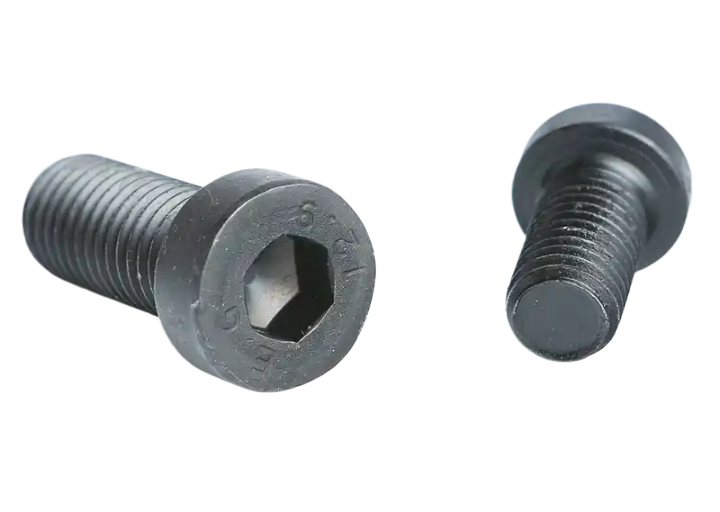
When engineers need the absolute maximum strength from a metric fastener — without increasing bolt diameter — they turn to Class 12.9 bolts. These ultra-high-strength fasteners represent the highest commonly available property class in ISO 898-1, delivering 1,200 MPa tensile strength and 1,080 MPa yield strength. They are the specialists of the fastener world: not for everyday use, but indispensable when the stakes — and the loads — are highest.
What Does Class 12.9 Mean? Decoding the Numbers
Metric bolt strength grades follow a simple two‑number system standardized under ISO 898‑1:2013. The numbers are not arbitrary — they directly tell you the bolt’s strength:
| Part of the marking | Calculation | Result |
|---|---|---|
| First number (12) | × 100 = Minimum ultimate tensile strength | 1,200 MPa |
| First number × second number (12 × 9) | × 10 = Minimum yield strength | 1,080 MPa |
Thus, a Class 12.9 bolt (or Grade 12.9 bolt) has:
-
Minimum tensile strength: 1,200 MPa (megapascals)
-
Minimum yield strength: 1,080 MPa (90% of tensile)
-
Elongation after fracture: 8% minimum
The “.9” indicates that the yield strength is 90% of the tensile strength — the same ratio as 10.9. However, the 1,080 MPa yield strength of 12.9 is 69% higher than 8.8‘s 640 MPa and 20% higher than 10.9’s 900 MPa.
The two numbers are always stamped on the bolt head. Metric 12.9 bolts are identified by the marking “12.9” embossed on the head, often accompanied by a manufacturer’s symbol.
Terminology note: In ISO standards, the correct term is “Class 12.9” . In North American markets, you may see “Grade 12.9 bolt” used interchangeably — both refer to the same specification.
Mechanical Properties of Class 12.9 Bolts
Per ISO 898‑1:2013, the mechanical requirements for Class 12.9 bolts are:
| Property | Requirement |
|---|---|
| Tensile strength (Rm), nominal | 1,200 MPa |
| Tensile strength (Rm), min | 1,220 MPa |
| Yield strength (Rp0.2), nominal | 1,080 MPa |
| Yield strength (Rp0.2), min | 1,100 MPa |
| Proof load stress (Sp), nominal | 970 MPa |
| Proof strength ratio | 0.88 |
| Elongation after fracture (A), min | 8% |
| Reduction of area (Z), min | 44% |
| Impact strength (Charpy V‑notch) | (Under investigation) |
Hardness Requirements
| Property | Requirement |
|---|---|
| Vickers hardness (HV), min | 385 |
| Vickers hardness (HV), max | 435 |
| Brinell hardness (HBW), min | 380 |
| Brinell hardness (HBW), max | 429 |
| Rockwell hardness (HRC), min | 39 |
| Rockwell hardness (HRC), max | 44 |
| Surface hardness (HV 0.3), max | 435 |
Material Composition and Heat Treatment
Class 12.9 bolts require mandatory alloy steel — plain carbon steel cannot achieve these strength levels reliably.
Alloy Steel Requirements (per ISO 898‑1)
For Class 12.9, ISO 898‑1 specifies alloy steel quenched and tempered, which must contain at least one of the following alloying elements:
| Element | Minimum Content |
|---|---|
| Chromium (Cr) | 0.30% |
| Nickel (Ni) | 0.30% |
| Molybdenum (Mo) | 0.20% |
| Vanadium (V) | 0.10% |
Chemical Composition Limits (Cast Analysis)
| Element | Min | Max |
|---|---|---|
| Carbon (C) | 0.28% | 0.50% |
| Phosphorus (P) | — | 0.025% |
| Sulfur (S) | — | 0.025% |
| Boron (B) | — | 0.003% |
SCM435: The Most Common 12.9 Material
In practice, SCM435 is the predominant material for Class 12.9 bolts, used in over 90% of cases. SCM435 is a chromium‑molybdenum alloy steel under the Japanese JIS G4105 standard, with composition and properties similar to 35CrMo (China), 4135 (USA), and 34CrMo4 (Germany).
| Element | SCM435 Composition (JIS G4105) | Function |
|---|---|---|
| Carbon (C) | 0.33–0.38% | Provides hardness and strength via martensite formation during quenching |
| Silicon (Si) | 0.15–0.35% | Deoxidizes steel; increases yield strength |
| Manganese (Mn) | 0.60–0.85% | Improves hardenability and combats sulfur‑induced brittleness |
| Chromium (Cr) | 0.90–1.20% | Boosts corrosion resistance and hardenability |
| Molybdenum (Mo) | 0.15–0.30% | Refines grain structure; enhances high‑temperature strength; reduces temper brittleness |
| Phosphorus (P) | ≤ 0.030% | Impurity — strictly controlled |
| Sulfur (S) | ≤ 0.030% | Impurity — strictly controlled |
Alternative Materials
| Material | Application |
|---|---|
| 35CrMo | Chinese equivalent to SCM435; widely available domestically |
| SCM440 | Higher molybdenum content; used for larger diameters or more demanding applications |
| 42CrMo | Ultra‑high-strength alloy; used for very large diameters |
Heat Treatment Process
Class 12.9 bolts must be quenched and tempered (through‑hardened). The typical heat treatment process for SCM435 is:
| Process | Temperature | Purpose |
|---|---|---|
| Quenching | 890–950°C | Rapid cooling to form martensite — the hard, strong microstructure |
| Tempering | 480–520°C | Relieves internal stresses; optimizes toughness while maintaining high strength |
ISO 898‑1 requires that the tempering temperature for Class 12.9 bolts be at least 380°C (for carbon steel with additives) or 425°C (for alloy steel). This ensures the bolts achieve the necessary combination of strength and toughness without becoming too brittle.
Class 12.9 vs. SAE (Imperial) Equivalent
For those familiar with imperial fasteners, here’s how Class 12.9 compares to SAE grades:
| Aspect | Metric Class 12.9 | SAE Grade 8 (imperial) |
|---|---|---|
| Tensile strength | 1,200 MPa (174,000 psi) | 150,000 psi (approx. 1,034 MPa) |
| Equivalent | No direct equivalent | Grade 8 is weaker |
Important: There is no direct SAE equivalent for Class 12.9. Grade 8 bolts (the strongest common imperial grade) have a tensile strength of approximately 150,000 psi (1,034 MPa) — significantly lower than Class 12.9‘s 174,000 psi. For applications requiring the strength of Class 12.9, imperial users typically need to switch to metric fasteners or specify specialty alloys.
Typical Applications for Class 12.9 Bolts
Class 12.9 bolts are specified where no lower grade will suffice — applications involving extreme loads, high stress, weight constraints, or safety‑critical assemblies.
Aerospace Engineering
Grade 12.9 screws are extensively used in aerospace engineering to fasten critical structural and engine components, including:
-
Wing assemblies and landing gear systems
-
Turbine housings and avionics mounts
-
Airframe structural connections where high strength‑to‑weight ratio is essential
Automotive Manufacturing
In automotive manufacturing, Grade 12.9 screws are used for components requiring the highest strength levels:
-
Cylinder heads, connecting rods, and crankshafts
-
Transmission systems and engine internals
-
Chassis and suspension systems where load reduction is critical
-
Lightweight, high‑performance suspension components (next‑generation vehicles use 12.9 and even 14.9 grade bolts to reduce weight)
Heavy Machinery and Construction
These bolts are ideal for applications in heavy machinery, automotive, and structural engineering projects:
-
Construction equipment requiring extreme load capacity
-
Bridges and industrial frameworks requiring high‑strength connections
-
Heavy‑duty mining equipment
-
Wind turbine towers and blade attachments
-
Oil rigs and power plants
Precision Machinery and Motorsports
-
Racing components and motorsport assemblies
-
High‑stress industrial machinery
-
Robotics and precision assemblies
-
Heavy industry and machine construction
Torque Guidelines for Class 12.9 Bolts
Proper tightening torque is essential to achieve the desired clamping force without over‑stressing the bolt. Below are recommended torque values for lubricated Class 12.9 bolts:
| Thread Size | Recommended Torque (Nm) |
|---|---|
| M6 | ~17 |
| M8 | ~40 |
| M10 | ~79 |
| M12 | ~136 |
| M16 | ~333 |
| M20 | ~649 |
| M24 | ~1,120 |
Note: Actual torque depends on lubrication, thread condition, and joint design. Always verify with engineering calculations. Use a calibrated torque wrench and avoid impact tools for critical applications.
How to Identify Class 12.9 Bolts
Class 12.9 bolts are identified by the marking “12.9” stamped on the bolt head. The marking is usually raised or indented and may include a manufacturer’s symbol.
Example head marking:
12.9 or 12.9 with a logo
Do not rely on color or surface finish — plating can vary (zinc, black oxide, Dacromet, etc.). Always check the head stamp.
Matching Nuts for Class 12.9 Bolts
Per ISO 898‑2, a Class 12 nut should be used with a Class 12.9 bolt. Using a lower‑strength nut risks thread stripping before the bolt reaches its full capacity.
| Bolt Grade | Recommended Nut Grade |
|---|---|
| Class 8.8 | Class 8 (or 10, 12) |
| Class 10.9 | Class 10 (or 12) |
| Class 12.9 | Class 12 |
Summary: Class 12.9 Bolts at a Glance
| Aspect | Specification |
|---|---|
| Standard | ISO 898‑1:2013 |
| Tensile strength (nominal/min) | 1,200 / 1,220 MPa |
| Yield strength (nominal/min) | 1,080 / 1,100 MPa |
| Elongation (min) | 8% |
| Hardness range | 39–44 HRC (385–435 HV) |
| Material | Mandatory alloy steel (SCM435, 35CrMo, 42CrMo, etc.) |
| Heat treatment | Quenched and tempered (380–425°C min temper) |
| Matching nut | Class 12 |
| SAE equivalent | No direct equivalent (stronger than Grade 8) |
| Relative cost | 1.8–2.2× Class 8.8 |
| Key advantage | Highest strength of any common metric grade |
| Key risk | Very high hydrogen embrittlement susceptibility |
| Primary applications | Aerospace, high‑performance automotive, heavy machinery, wind turbines, racing |
Frequently Asked Questions
Q: Is “Class 12.9” the same as “Grade 12.9”?
A: Yes. “Class” is the ISO term, but “Grade” is widely used in North America. Both refer to the same specification.
Q: How much stronger is 12.9 than 8.8 and 10.9?
A: 50% higher tensile strength than 8.8 (1,200 vs. 800 MPa); 20% higher than 10.9 (1,200 vs. 1,000 MPa). Yield strength is 69% higher than 8.8 and 20% higher than 10.9.
Q: Is there an SAE (imperial) equivalent for Class 12.9?
A: No. SAE Grade 8 has a tensile strength of approximately 150,000 psi (1,034 MPa) — significantly lower than Class 12.9‘s 174,000 psi.
Q: Can I use Class 12.9 bolts outdoors?
A: Yes, but surface finish selection is critical. Standard zinc plating is strongly discouraged due to hydrogen embrittlement risk. Specify zinc flake coatings (Dacromet, Geomet, Delta) — these are applied without acid and do not introduce hydrogen.
Q: Are Class 12.9 bolts brittle?
A: More brittle than both 8.8 (12% elongation) and 10.9 (9% elongation), with only 8% elongation. They require precise torque control and careful assembly.
Q: What is the maximum diameter for Class 12.9 bolts?
A: ISO 898‑1 covers diameters from M6 to M64. However, hardenability decreases with diameter. Above M20–M24, many suppliers use higher alloy content (e.g., 42CrMo instead of SCM435) to ensure core hardness. Always verify with your supplier.
Q: Can I electroplate Class 12.9 bolts?
A: Strongly discouraged. If unavoidable, you must specify baking within 4 hours at 200°C. However, even with baking, a guarantee of complete elimination of hydrogen embrittlement risk cannot be given. For critical applications, specify non‑electrolytic finishes (zinc flake coatings) instead.
 No products in the cart.