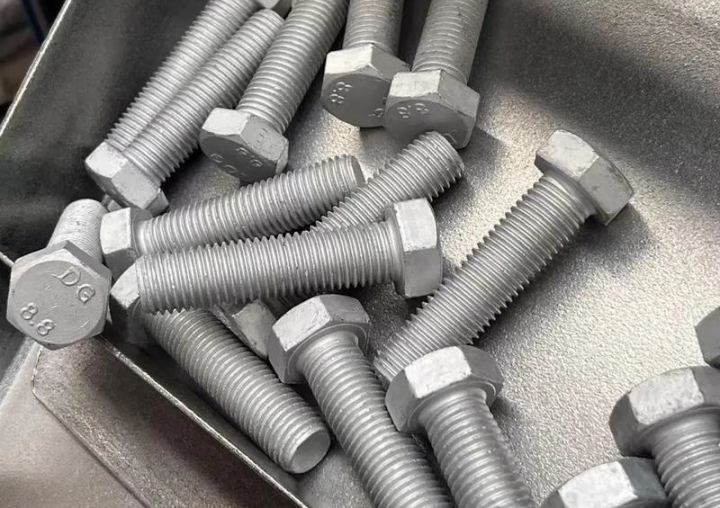
When engineers and procurement professionals search for Class 8.8 bolts — also widely known as Grade 8.8 bolts — they are looking for a reliable, cost‑effective metric fastener. Both terms refer to the same ISO strength specification (ISO 898‑1). This guide covers everything you need to know about this most widely used metric bolt grade, whether you call it Class 8.8 or Grade 8.8.
But what exactly does “Class 8.8” mean? How strong is an 8.8 bolt compared to other grades? And when should you specify it?
This article provides a complete guide to Class 8.8 bolts — covering the meaning of the numbers, mechanical properties, material composition and applications.
What Does Class 8.8 Mean? Decoding the Numbers
Metric bolt strength grades follow a simple two‑number system standardized under ISO 898‑1. The numbers are not arbitrary — they directly tell you the bolt’s strength:
| Part of the marking | Calculation | Result |
|---|---|---|
| First number (8) | × 100 = Minimum ultimate tensile strength | 800 MPa |
| First number × second number (8 × 8) | × 10 = Minimum yield strength | 640 MPa |
Thus, a Class 8.8 bolt (or Grade 8.8 bolt) has:
-
Minimum tensile strength: 800 MPa (megapascals)
-
Minimum yield strength: 640 MPa (80% of tensile)
-
Elongation after fracture: 12% minimum (good ductility)
The two numbers are generally stamped on the bolt head, often with a manufacturer’s mark.
Terminology note: In ISO standards, the correct term is “Class 8.8”. However, in North American markets, you may see “Grade 8.8 bolt” used interchangeably. Both refer to the same specification.
Mechanical Properties of Class 8.8 Bolts
Per ISO 898‑1:2013, the mechanical requirements for Class 8.8 bolts are:
| Property | Requirement |
|---|---|
| Tensile strength (Rm), min | 800 MPa |
| Yield strength (Rp0.2), min | 640 MPa |
| Proof load stress (Sp), nominal | 580–600 MPa (depends on thread size) |
| Elongation after fracture (A), min | 12% |
| Reduction of area (Z), min | 52% |
| Hardness (HV) | 250–335 HV |
| Hardness (HRC) | 22–32 HRC |
| Impact strength (Charpy V‑notch) | 27 J at 20°C (for sizes ≥ M16) |
These properties are verified by testing finished bolts, not raw material. The 12% elongation means Class 8.8 bolts are relatively ductile — they will visibly stretch before breaking, providing warning of overload.
Material Composition and Heat Treatment
Class 8.8 bolts are typically made frommedium‑carbon steel or boron‑treated carbon steel. The exact composition varies by manufacturer, but ISO 898‑1 provides guidance:
| Element | Typical Range / Requirement |
|---|---|
| Carbon (C) | 0.15–0.55% (depending on diameter) |
| Manganese (Mn) | 0.60% minimum |
| Phosphorus (P) | ≤ 0.025% |
| Sulfur (S) | ≤ 0.025% |
| Boron (B) | Optional (added to improve hardenability) |
Heat treatment: Class 8.8 bolts must be quenched and tempered (through‑hardened). The tempering temperature must be at least 425°C to avoid brittleness. This heat treatment creates a microstructure of tempered martensite or tempered sorbite, providing the optimal combination of strength and toughness.
Diameter limitation: Due to lower hardenability compared to alloy steels, Class 8.8 bolts in larger diameters (typically above M24) may not fully harden through the core. For larger sizes, consider moving to Class 10.9 or specifying alloy steel.
Class 8.8 vs. Other Strength Grades
Here’s how Class 8.8 compares to the higher grades:
| Grade | Tensile (MPa) | Yield (MPa) | Elongation | Hardness (HRC) | Relative Cost |
|---|---|---|---|---|---|
| 8.8 | 800 | 640 | 12% | 22–32 | Baseline (1×) |
| 10.9 | 1,000 | 900 | 9% | 32–39 | 1.3–1.5× |
| 12.9 | 1,200 | 1,080 | 8% | 39–44 | 1.8–2.2× |
Key takeaway: Class 8.8 offers the best balance of strength and ductility for most applications. It is significantly more ductile than 10.9 or 12.9, making it more forgiving during assembly and less sensitive to stress concentrations.
Class 8.8 vs. SAE Grade 5 (Imperial)
For those familiar with imperial fasteners, here’s how Class 8.8 compares to SAE Grade 5:
| Aspect | Metric Class 8.8 | SAE Grade 5 (imperial) |
|---|---|---|
| Tensile strength | 800 MPa (116,000 psi) | 120,000 psi (approx. 830 MPa) |
| Yield strength | 640 MPa (93,000 psi) | 92,000 psi (approx. 635 MPa) |
| Equivalent | Nearly identical | Nearly identical |
For practical purposes, Class 8.8 and SAE Grade 5 are considered equivalent in strength. However, they are not interchangeable due to different thread standards (metric vs. inch).
Typical Applications for Class 8.8 Bolts
Class 8.8 bolts are the go‑to choice for countless engineering applications:
| Industry | Typical Applications |
|---|---|
| General machinery | Equipment assembly, gearbox housings, pump flanges |
| Automotive (non‑critical) | Body panels, brackets, engine accessories |
| Construction | Light structural connections, building frames, support beams |
| Agricultural equipment | Tractors, harvesters, implements |
| Industrial equipment | Conveyor systems, packaging machinery, steel mills (secondary) |
| Furniture and fixtures | Heavy‑duty shelving, workbenches |
Torque Guidelines for Class 8.8 Bolts
Proper tightening torque is essential to achieve the desired clamping force without over‑stressing the bolt. Below are recommended torque values for lubricated Class 8.8 bolts (dry torque would be higher):
| Thread Size | Recommended Torque (Nm) |
|---|---|
| M6 | ~10 |
| M8 | ~24 |
| M10 | ~47 |
| M12 | ~81 |
| M16 | ~197 |
| M20 | ~385 |
| M24 | ~665 |
Note: Actual torque depends on lubrication, thread condition, and joint design. Always verify with engineering calculations.
How to Identify Class 8.8 Bolts
Class 8.8 bolts are identified by the marking “8.8” stamped on the bolt head. The marking is usually raised or indented, and may include a manufacturer’s symbol.
Example head marking:
8.8 or 8.8 with a logo
Do not rely on color or surface finish — plating can vary (zinc, black oxide, Dacromet, etc.). Always check the head stamp.
Matching Nuts for Class 8.8 Bolts
Per ISO 898‑2, a Class 8 nut (or higher) should be used with a Class 8.8 bolt. Using a lower‑strength nut risks thread stripping before the bolt reaches its full capacity.
| Bolt Grade | Recommended Nut Grade |
|---|---|
| Class 8.8 | Class 8 (or 10, 12) |
Summary: Class 8.8 Bolts at a Glance
| Aspect | Specification |
|---|---|
| Standard | ISO 898‑1 |
| Tensile strength (min) | 800 MPa |
| Yield strength (min) | 640 MPa |
| Elongation (min) | 12% |
| Hardness range | 22–32 HRC (250–335 HV) |
| Material | Medium‑carbon steel or boron‑treated carbon steel |
| Heat treatment | Quenched and tempered (≥425°C) |
| Matching nut | Class 8 |
| SAE equivalent | Grade 5 |
| Typical applications | General machinery, automotive non‑critical, construction, agricultural equipment |
| Relative cost | Baseline (most economical heat‑treated grade) |
Frequently Asked Questions
Q: Is “Class 8.8” the same as “Grade 8.8”?
A: Yes. “Class” is the ISO term, but “Grade” is widely used in North America. They refer to the same specification.
Q: Can I use Class 8.8 bolts in marine environments?
A: The strength grade is fine, but the finish matters. Standard zinc plating will not last long in salt water. Specify a corrosion‑resistant finish such as Dacromet, Geomet, or hot‑dip galvanizing.
Q: What is the maximum diameter for Class 8.8 bolts?
A: There is no absolute maximum, but hardenability decreases with diameter. Above M24, many suppliers may use alloy steel (e.g., 40Cr) to ensure core hardness. Always verify with your supplier.
Q: Are Class 8.8 bolts brittle?
A: No. With 12% elongation, they are relatively ductile. They will stretch before breaking, unlike higher grades (10.9/12.9) which are more brittle.
 No products in the cart.