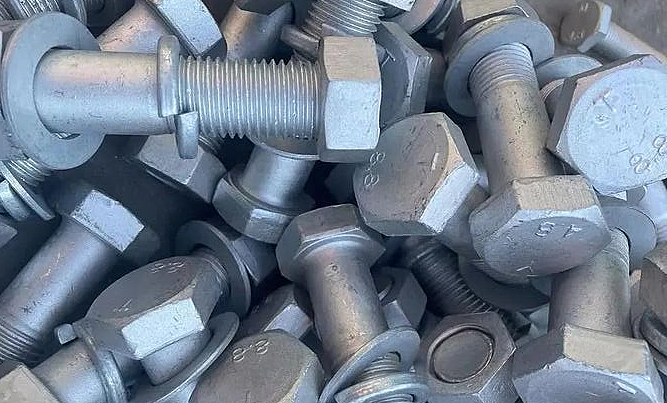
When fasteners need to survive decades outdoors—on transmission towers, highway guardrails, or coastal structures—hot-dip galvanizing is the finish of choice.
Unlike the thin zinc layer applied by electroplating, hot-dip galvanizing creates a thick, metallurgically bonded coating that can protect steel for 30 to 70 years, depending on the environment.
What Is Hot-Dip Galvanizing?
Hot-dip galvanizing is a process where steel components are immersed in a bath of molten zinc at approximately 450°C (840°F). The zinc metallurgically reacts with the iron in the steel, forming a series of zinc-iron alloy layers that become an integral part of the fastener surface.
The result is a coating that is:
-
Thick: Typically 45-85 μm on threaded fasteners
-
Metallurgically bonded: Not just adhered, but alloyed with the base steel
-
Durable: Resists mechanical damage better than plated coatings
-
Self-healing: Scratches can form zinc carbonate patina that reseals the surface
The Hot-Dip Galvanizing Process for Fasteners
For small parts like bolts, nuts, and washers, a specialized process called centrifugal galvanizing (or spin galvanizing) is used:
-
Surface preparation: Parts are degreased, pickled in acid to remove rust and scale, and fluxed to prevent oxidation before galvanizing
-
Galvanizing: Parts are immersed in molten zinc (98.5% pure minimum) at approximately 450°C (standard) or up to 530°C (high-temperature process) for specific applications
-
Centrifuging: Immediately after removal from the zinc bath, parts are spun at high speed to remove excess zinc, ensuring clean threads and uniform coating
-
Inspection: Coating thickness, uniformity, and appearance are verified
This centrifugal process is essential for fasteners—without it, threads would be clogged with zinc and nuts would not fit.
Coating Thickness Requirements
Hot-dip galvanized coatings are significantly thicker than electroplated zinc. For centrifuged fasteners, international standards specify minimum coating thicknesses:
| Thread Size | Minimum Local Coating | Minimum Mean Coating |
|---|---|---|
| > 6 mm | 40 μm (285 g/m²) | 50 μm (360 g/m²) |
| ≤ 6 mm | 20 μm (145 g/m²) | 25 μm (180 g/m²) |
Based on EN ISO 1461 for centrifuged articles
For comparison, standard electroplated zinc is typically only 5-12 μm thick. This thickness difference is why hot-dip galvanizing lasts decades while electroplating lasts years.
ASTM A153 is the corresponding North American standard for hot-dip galvanizing of hardware items.
Hot-Dip Galvanizing vs. Zinc Electroplating
| Aspect | Hot-Dip Galvanizing | Zinc Electroplating |
|---|---|---|
| Coating thickness | 40-85 μm (typical) | 5-12 μm (typical) |
| Process temperature | ~450°C (molten zinc) | Room temperature (electrochemical) |
| Coating structure | Metallurgical alloy layers + pure zinc | Pure zinc layer only |
| Corrosion resistance | High—30-70 years outdoors | Moderate—indoor use only |
| Thread fit | Requires oversize tapping (class 6AZ/6A) | Standard thread class acceptable |
| Appearance | Matte gray | Bright silver or yellow |
| Hydrogen embrittlement risk | Low (no acid charging) | High (requires baking) |
| Cost | $$ (moderate) | $ (low) |
Advantages of Hot-Dip Galvanizing
✅ Superior Corrosion Protection
The thick, multi-layer coating provides excellent resistance even in marine and industrial environments.
✅ Metallurgical Bonding
The zinc-iron alloy layers are integral to the steel, not just adhered—coating won’t peel or flake.
✅ Self-Healing Properties
If scratched, exposed zinc can form zinc carbonate patina that reseals small damaged areas.
✅ No Hydrogen Embrittlement
The process doesn’t introduce hydrogen, making it safe for high-strength fasteners.
✅ Long Service Life
Decades of maintenance-free protection, proven in real-world applications from transmission towers to highway guardrails.
✅ Full Coverage
Molten zinc reaches into crevices and hollow sections that electroplating can’t cover.
Ideal Applications
-
Outdoor structures (transmission towers, light poles, signage)
-
Highway hardware (guardrails, bridge components)
-
Marine and coastal construction
-
Industrial facilities with corrosive atmospheres
-
Infrastructure with 30+ year design life
-
Any application where future maintenance is difficult or expensive
Summary: Hot-Dip Galvanizing at a Glance
| Aspect | Summary |
|---|---|
| Process | Immersion in molten zinc (~450°C) + centrifuging |
| Coating thickness | 40-85 μm (depends on thread size) |
| Corrosion resistance | High—30-70 years outdoor service |
| Thread fit | Requires oversize tapping (Class 6AZ/6A) |
| Hydrogen embrittlement | No risk—safe for high-strength grades |
| Appearance | Matte gray (zinc carbonate patina) |
| Best for | Outdoor structures, infrastructure, marine, industrial |
| Standards | ASTM A153, EN ISO 1461, AS/NZS 4680 |
 No products in the cart.